Safety Rate
Your heart works every second of every day. When the arteries that supply blood to your heart get blocked or narrow, it puts your heart under serious strain. Coronary angioplasty and stenting is a proven, minimally invasive procedure that opens up these blocked arteries and restores proper blood flow — without the need for open-heart surgery.
At KSM Heart Clinic, Chennai, Dr. Karthik Sabapathi has helped hundreds of patients reclaim their heart health through this procedure. Whether you are experiencing chest pain, recovering from a heart attack, or your medications have not been giving you enough relief, angioplasty may be the right step forward for you.
Coronary angioplasty, also known as Percutaneous Coronary Intervention (PCI), is a non-surgical procedure used to open up arteries that have become blocked or narrowed due to plaque buildup. Plaque is a fatty deposit that gradually builds up inside artery walls over time, making it harder for blood to flow through to the heart muscle.
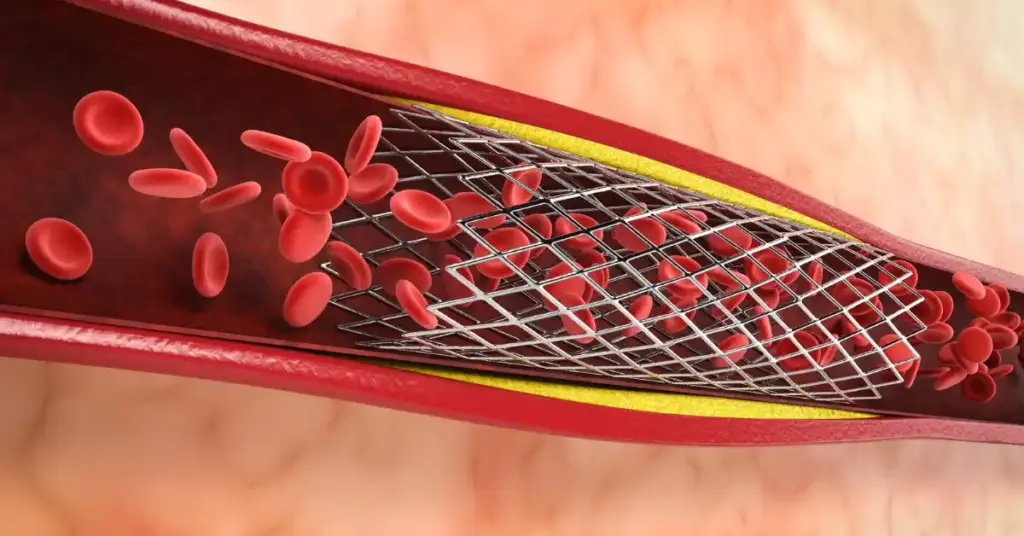
During the procedure, a thin, flexible tube called a catheter is guided through a blood vessel — usually from the wrist or groin — and advanced toward the blocked artery in the heart. A tiny balloon at the tip of the catheter is then inflated to push the plaque against the artery walls and widen the passage. In most cases, a small mesh tube called a stent is placed in the artery to keep it open permanently.
Coronary angioplasty with balloon and stenting is now the most common treatment for blocked coronary arteries worldwide. It is safe, effective, and can be performed as an emergency treatment during a heart attack or as a planned procedure.
Coronary artery disease (CAD) happens when the arteries supplying blood to your heart become narrowed or blocked. It develops slowly over many years and often does not show any obvious signs until the blockage becomes significant. Knowing the symptoms can help you get the right care at the right time.
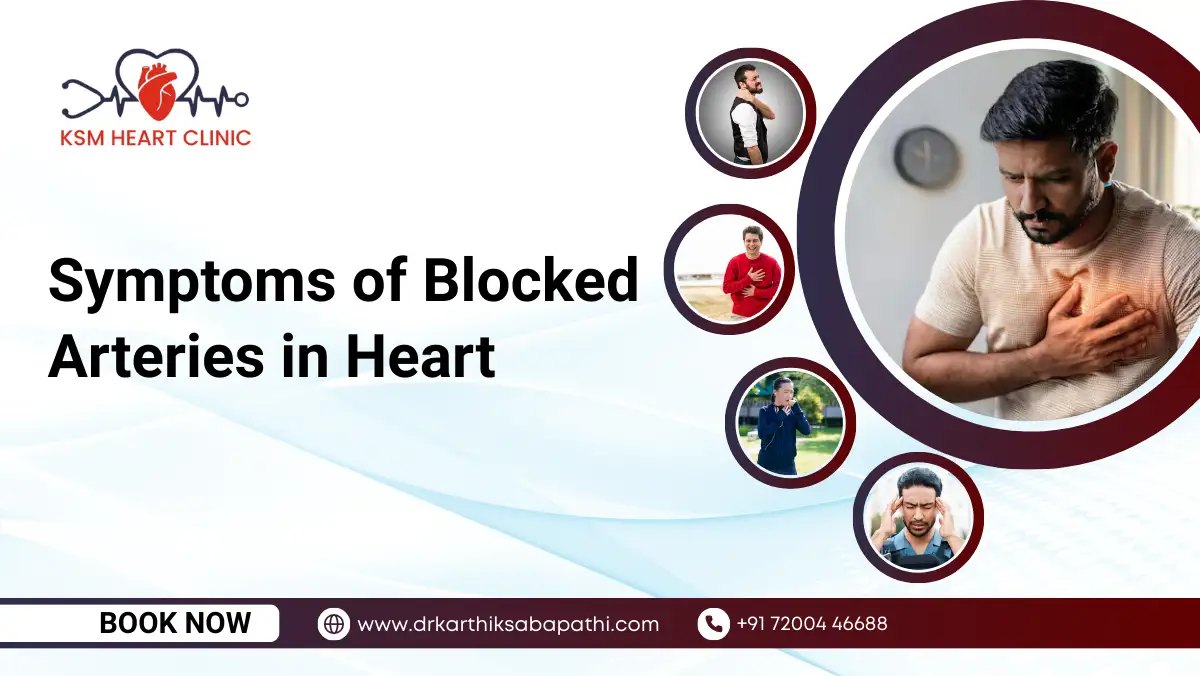
The most common symptom of coronary artery disease is chest discomfort, often described as a tightness, pressure, squeezing, or heaviness in the chest. This is called angina. It usually happens during physical activity or emotional stress and goes away with rest.
Other common warning signs include:
In the early stages of coronary artery disease, symptoms are usually mild and may only appear during exertion. You might notice a little chest tightness when you walk uphill or climb stairs, but it passes quickly when you rest. Many people dismiss these early signs or attribute them to stress or age.
As the blockage grows, symptoms become more frequent and occur even during light activity or rest. Chest pain may last longer and become harder to relieve. In advanced cases, blood flow to the heart is so restricted that even simple daily activities become difficult.
You should see a cardiologist right away if you experience chest pain that lasts more than a few minutes, pain that spreads to your arm, jaw, or back, sudden shortness of breath, or if you feel faint. These could be signs of a heart attack. Getting prompt medical attention can save your heart muscle from permanent damage.
At KSM Heart Clinic, Dr. Karthik Sabapathi is available for urgent consultation and can guide you on the next steps based on your symptoms.
Not everyone with coronary artery disease will feel chest pain or obvious symptoms. Some people — especially those with diabetes — may have what is called silent ischaemia, where the heart is not getting enough blood but there are no noticeable symptoms.
This makes regular heart check-ups important, especially if you have risk factors like high blood pressure, high cholesterol, diabetes, smoking, or a family history of heart disease. Early detection through tests like an ECG, stress test, or coronary angiography can identify the problem before it becomes an emergency.
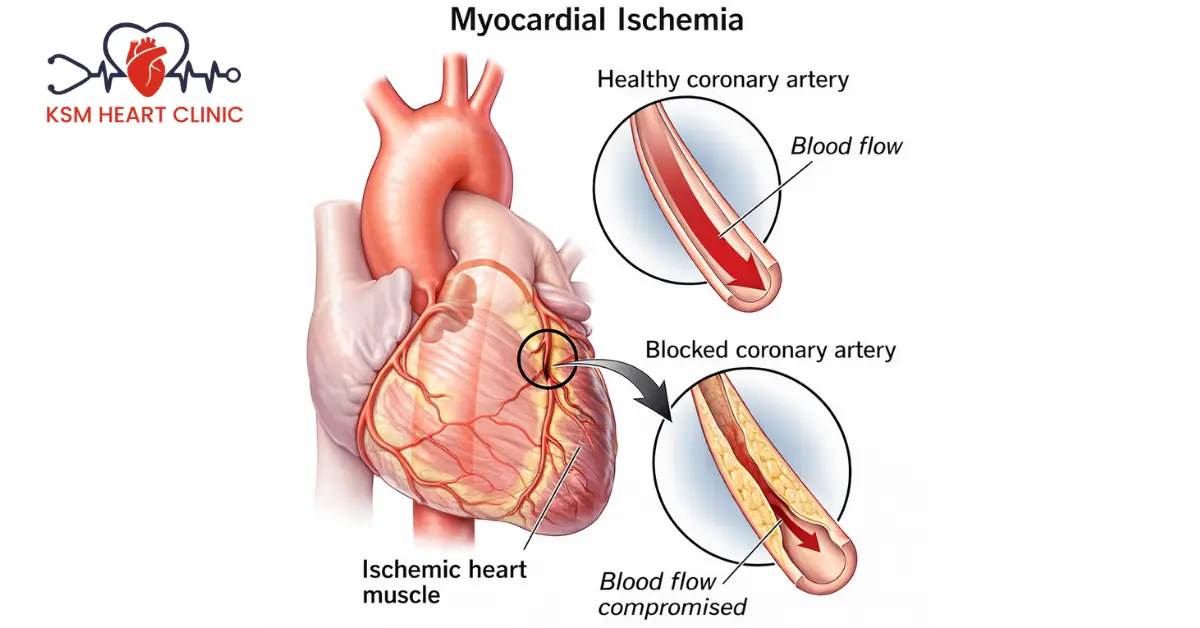
Coronary angioplasty is recommended when the arteries supplying blood to the heart become too narrow or blocked and when other treatments are not enough to manage the condition. Here are the most common reasons patients undergo this procedure:
The primary reason for coronary angioplasty is the presence of significant blockages in the coronary arteries. When fatty deposits called plaque narrow the inner walls of an artery by 70% or more, blood flow to the heart is severely compromised. This leads to chest pain, breathlessness, and reduced heart function.
Dr. Karthik Sabapathi identifies the exact location and severity of the blockage through a coronary angiogram before recommending angioplasty. The procedure directly addresses the site of narrowing and restores adequate blood flow to the heart.
During a heart attack, one of the coronary arteries is suddenly blocked — most often by a blood clot forming over a ruptured plaque. Every minute matters because heart muscle cells begin to die when they do not receive oxygen.
Emergency coronary angioplasty, also called primary PCI, is the fastest and most effective way to open a blocked artery during a heart attack. When performed within the recommended time window, it can dramatically reduce the amount of heart muscle damage and improve survival.
For some patients, medications like nitrates, beta-blockers, and cholesterol-lowering drugs, combined with lifestyle changes such as a heart-healthy diet and regular exercise, are enough to manage coronary artery disease. However, when these measures no longer provide adequate relief, or when the disease is too advanced, angioplasty becomes necessary.
If you are still experiencing chest pain or shortness of breath despite taking your medications as prescribed, it is a clear signal that your arteries need direct treatment. Dr. Karthik Sabapathi will review your case and determine whether angioplasty is the right option for you.
Beyond treating emergencies and managing disease, coronary angioplasty makes a real difference to how patients feel and live every day. Many people who undergo the procedure report a significant reduction in chest pain, improved ability to exercise and perform daily activities, better sleep, and reduced dependence on medications.
Angioplasty gives patients the ability to live life more freely, without the constant concern of chest pain or shortness of breath limiting their activities.
Coronary angioplasty is one of the most important advances in modern heart care. Compared to open-heart bypass surgery, it is far less invasive and offers several meaningful advantages:
One of the most satisfying outcomes of coronary angioplasty is how quickly patients experience relief. Once the blocked artery is opened and the stent is in place, blood flows freely again. Most patients notice a significant reduction in chest pain and breathlessness almost immediately after the procedure.
This rapid improvement is particularly important for patients who have been living with persistent angina that limits their daily activities. Angioplasty can change their experience within hours.
By opening up significantly blocked arteries before they cause a complete blockage, angioplasty reduces the risk of a future heart attack. A stent holds the artery open and keeps blood flowing, making it far less likely for a sudden blockage to occur at the treated site.
For patients who have already had a heart attack, angioplasty minimises further damage to the heart and reduces the risk of another cardiac event when combined with appropriate medications and lifestyle changes.
Because angioplasty is performed through a small puncture in the wrist or groin rather than through open surgery, recovery is much faster. Most patients stay in hospital for one to two days and can return to light daily activities within a week.
There are no large incisions to heal, no chest opening, and no prolonged rehabilitation required. This makes angioplasty a much more practical choice for many patients, especially those with other health conditions that make major surgery risky.
Like any medical procedure, coronary angioplasty and stenting carries some risks. It is important for patients to be fully informed so they can make confident decisions about their care. Dr. Karthik Sabapathi discusses all risks openly with every patient before the procedure.
Most patients experience only minor, temporary side effects, which include:
These side effects are generally short-lived and resolve on their own within a few days. The medical team at KSM Heart Clinic monitors every patient closely to ensure a safe recovery.
Serious complications are uncommon but can occur in rare cases. These include arterial injury at the access site, blood clots forming around the stent (called stent thrombosis), a small risk of stroke, or, in very rare situations, a heart attack during the procedure.
The risk of restenosis — where the artery narrows again over time — has been greatly reduced with the use of modern drug-eluting stents, which release medication to prevent excessive tissue growth inside the artery.
Certain patient factors can influence the level of risk associated with the procedure:
Dr. Karthik Sabapathi evaluates each patient's individual health profile carefully to determine the safest approach and whether angioplasty is the most appropriate treatment option.
At KSM Heart Clinic, patient safety is the first priority. Before any procedure, a thorough evaluation is carried out including blood tests, kidney function tests, ECG, and imaging studies. Pre-hydration is given to patients with kidney concerns, and medications to reduce the risk of blood clots are prescribed.
During the procedure, the team monitors the patient's heart rhythm, blood pressure, and oxygen levels continuously. After the procedure, patients remain under observation until the care team is confident the recovery is progressing well.
Both coronary angioplasty and bypass surgery are effective treatments for blocked coronary arteries. The choice between the two depends on the nature of the blockages, the patient's overall health, and what the heart surgeon and cardiologist recommend together.
Coronary angioplasty is performed through a small tube inserted into a blood vessel. It is minimally invasive, does not require general anaesthesia in most cases, and does not involve cutting open the chest. Bypass surgery, on the other hand, is an open-heart operation. The surgeon creates a new pathway for blood to flow around the blocked artery using a graft taken from another blood vessel in the body.
Angioplasty is a same-day or short-stay procedure, while bypass surgery typically requires a hospital stay of five to seven days and a recovery period of six to twelve weeks.
Angioplasty is generally the preferred choice when:
Bypass surgery may be a better option when:
Recovery after angioplasty is straightforward. Most patients are discharged within one to two days and can resume light activities within a week. There is no incision to heal and no restriction on arm or shoulder movement.
Recovery after bypass surgery is longer and more demanding. The chest needs time to heal, physical activity is restricted for several weeks, and intensive cardiac rehabilitation is usually required. However, bypass surgery may offer longer-lasting results in complex multi-vessel disease.
Dr. Karthik Sabapathi will help you understand which procedure is right for your specific situation based on your diagnostic results and overall health.
Understanding what happens during coronary angioplasty and stenting can help patients feel more comfortable and prepared. The procedure is performed in a specialised room called a cardiac catheterisation laboratory or cath lab.
The patient is made comfortable on the procedure table and connected to monitors that track heart rate, blood pressure, and oxygen levels. A local anaesthetic is applied to the access site — usually the wrist (radial artery) or the groin (femoral artery) — so the patient feels no pain during catheter insertion.
A thin, flexible tube called a sheath is placed into the artery. The catheter is then guided through this sheath and carefully advanced toward the coronary arteries. A special dye is injected through the catheter so the arteries become visible on X-ray images — this is the angiogram part of the procedure, which shows exactly where the blockage is and how severe it is.
The whole procedure typically takes between 30 minutes and two hours depending on the complexity of the blockage.
Once the blocked artery is identified, a guidewire is carefully passed through the catheter and across the blockage. A second catheter — this one with a small, deflated balloon at its tip — is then threaded over the guidewire to the site of the blockage.
The balloon is inflated for about 30 to 60 seconds. This pushes the plaque against the artery walls, compressing it and widening the channel for blood to flow through. The balloon may be inflated several times to ensure the artery is adequately opened. The patient may feel mild pressure during this step but should not feel pain.
In most cases, a stent is placed to prevent the artery from narrowing again. A stent is a small, expandable mesh tube made of metal. It is mounted on a balloon catheter and delivered to the site of the blockage.
When the balloon is inflated, the stent expands outward and locks into place against the artery wall. The balloon is then deflated and removed, but the stent remains permanently, holding the artery open like a scaffold.
At KSM Heart Clinic, drug-eluting stents are used in appropriate cases. These stents are coated with a medication that is slowly released into the surrounding artery wall, significantly reducing the chance of the artery narrowing again over time.
Good preparation helps ensure the procedure goes smoothly and reduces the risk of complications. Dr. Karthik Sabapathi and the team at KSM Heart Clinic will give patients a clear set of instructions to follow in the days leading up to the procedure.
Before the procedure, patients will typically undergo a series of tests:
These tests give Dr. Karthik Sabapathi a complete picture of your heart health and help plan the safest and most effective approach.
Certain medications need to be adjusted or stopped before the procedure. Blood-thinning medications such as warfarin may need to be paused for a specified period. Some diabetes medications, particularly metformin, are usually held for 48 hours before and after the procedure if contrast dye is being used, to protect kidney function.
It is important to share a complete list of all your medications — including over-the-counter drugs and supplements — with Dr. Karthik Sabapathi before the procedure. Do not stop or change any medication without medical guidance.
Patients are usually asked to fast — that is, to avoid eating or drinking anything except water — for at least six to eight hours before the procedure. This is a standard safety precaution.
Patients are also asked to:
Before any procedure, Dr. Karthik Sabapathi takes the time to sit down with the patient and their family to explain everything in clear, simple language. This includes what the procedure involves, what to expect during and after, the possible risks and benefits, and any alternatives available.
Patients are encouraged to ask any questions they have. Once all questions are answered and the patient is comfortable, a formal consent form is signed. No procedure is carried out unless the patient fully understands and agrees to proceed.
Recovery after coronary angioplasty and stenting is generally quick and straightforward. Most patients are pleasantly surprised by how soon they start feeling better.
After the procedure, patients are moved to a recovery area where they are monitored for a few hours. Vital signs — heart rate, blood pressure, oxygen levels — are checked regularly. The catheter access site is examined for any bleeding or bruising.
Most patients are discharged the following day. In emergency cases or when the procedure is more complex, the hospital stay may be slightly longer. The team will not discharge a patient until they are satisfied that the recovery is on track.
In the first week after the procedure:
Most patients can return to desk work within a week and to more active routines within two to four weeks, depending on their individual recovery. Dr. Karthik Sabapathi will provide a personalised activity plan based on each patient's condition.
After having a stent placed, patients are prescribed dual antiplatelet therapy — typically aspirin combined with another antiplatelet medication such as clopidogrel or ticagrelor. This combination is essential to prevent blood clots from forming on the stent.
It is critically important to take these medications exactly as prescribed and not stop them without first consulting Dr. Karthik Sabapathi. Stopping antiplatelet therapy too early significantly increases the risk of stent thrombosis, which is a serious complication. Other medications such as statins, blood pressure medications, and heart rate-controlling drugs may also be continued or newly started as part of the treatment plan.
Regular follow-up appointments are an important part of long-term heart health after angioplasty. At KSM Heart Clinic, follow-up visits are scheduled at one month, three months, six months, and one year after the procedure, and annually thereafter.
Long-term lifestyle changes also play a key role in keeping the heart healthy:
At KSM Heart Clinic in Chennai, every patient who walks through the door is treated as an individual, not a case number. Dr. Karthik Sabapathi has built the clinic on the belief that great heart care is about combining clinical excellence with genuine human compassion.
Before recommending any procedure, Dr. Karthik Sabapathi spends time listening to each patient — understanding their symptoms, their concerns, their lifestyle, and their goals. Treatment decisions are made together, not just for the patient, but with them.
Family members are welcome to be part of consultations. The team believes that when patients and their families are well informed and involved, recovery outcomes are consistently better.
KSM Heart Clinic is equipped with modern cardiac catheterisation facilities that allow for precise, high-quality angioplasty procedures. The use of digital imaging, intravascular ultrasound (IVUS), and fractional flow reserve (FFR) measurements allows Dr. Karthik Sabapathi to assess blockages with a level of accuracy that standard angiography alone cannot provide.
Drug-eluting stents of the latest generation are used where appropriate, significantly reducing the risk of restenosis. The radial (wrist) approach is used whenever possible as it is more comfortable for patients and associated with fewer access site complications.
Dr. Karthik Sabapathi is an experienced interventional cardiologist with extensive training in coronary angioplasty, stenting, and complex cardiac interventions. He has performed a large number of angioplasty procedures, including emergency primary PCI for heart attacks.
The team at KSM Heart Clinic includes trained cardiac nurses, catheterisation lab technicians, and support staff who work in close coordination to ensure every procedure is carried out safely and every patient is cared for with professionalism and warmth.
No two patients are the same, and recovery after angioplasty depends on a range of individual factors — age, overall health, severity of heart disease, and lifestyle. At KSM Heart Clinic, every patient receives a personalised recovery and aftercare plan that covers medications, activity guidelines, dietary recommendations, and follow-up schedules.
Patients also have access to Dr. Karthik Sabapathi's team for guidance and support between appointments if they have any concerns during their recovery.
Coronary angioplasty and stenting is one of the most effective, safe, and widely performed procedures in modern cardiology. It opens blocked arteries, restores blood flow to the heart, relieves chest pain, and significantly reduces the risk of a heart attack — all without the need for open-heart surgery.
If you or someone in your family is living with chest pain, shortness of breath, or has been diagnosed with coronary artery disease, getting the right guidance early can make all the difference. At KSM Heart Clinic in Chennai, Dr. Karthik Sabapathi brings together clinical expertise, advanced technology, and personalised care to give every patient the best possible outcome.
Your heart deserves the best care. Reach out to KSM Heart Clinic today to schedule a consultation with Dr. Karthik Sabapathi.
Having a stent put in is a serious but generally safe procedure. It treats blocked coronary arteries and restores blood flow to the heart. Though minimally invasive, it requires skilled medical care and follow-up. Most patients recover well, but long-term success depends on medication, lifestyle changes, and regular heart check-ups.
Recovery from coronary angioplasty and stent placement is usually quick. Most patients can return home within 24 hours and resume normal activities in about a week. Mild soreness or fatigue may occur initially. With proper rest, medication, and a heart-healthy lifestyle, full recovery and improved heart function are achievable within weeks.
Yes, most people can live a completely normal and active life after getting a stent. It improves heart function and relieves chest pain. However, long-term success depends on maintaining a healthy diet, exercising regularly, quitting smoking, and following prescribed medications. With care, patients enjoy improved quality of life and heart health.
Our experienced anaesthesiologists are here to ensure your safety and comfort